
The Price of
Doing It All Yourself
Most business owners think they're saving money by handling everything in-house. The numbers tell a different story.
There's a particular kind of pride that comes with running a lean business. No bloated team, no unnecessary spend. Just you, doing what needs to be done.
It's a reasonable instinct. But there's a version of it that quietly costs you far more than hiring help ever would. It's the version where "doing it yourself" has become a habit so ingrained you've stopped asking whether it actually makes sense.
Let's look at what it's actually costing.
Your Time Has a Rate. Use It.
If you charge clients $150 an hour, your time is worth $150 an hour. Full stop. Every hour you spend on a task that isn't billable, isn't building the business, and isn't something only you can do — that's $150 quietly walking out the door.
Most business owners spend somewhere between 10 and 15 hours a week on admin. At $150 an hour, that's $1,500 to $2,250 a week. Or roughly $100,000 a year, in time alone.
Not cash you've spent. Time you've lost. Which, depending on your stage, might actually be worse.
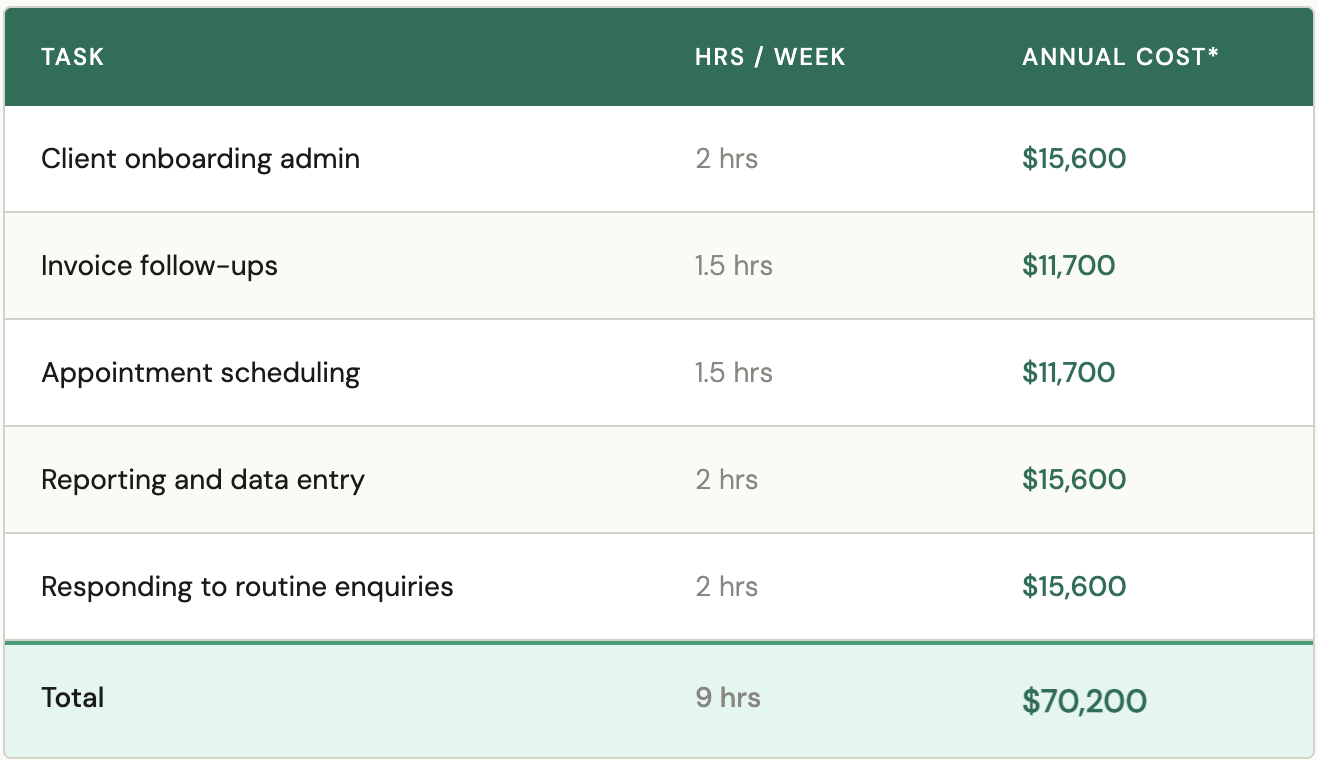
* Based on a $150/hr effective rate. Your numbers may vary — but the principle holds.
"You didn't start your business to spend it doing things a well-designed system could handle in seconds."
The Cost You Can't Put on a Spreadsheet
The financial cost is the easy part to calculate. Harder to quantify, but just as real , is what all that context-switching does to your thinking.
Every time you stop what you're doing to send a reminder email, chase a form, or update a spreadsheet, you lose something. Researchers call it attention residue: the mental cost of switching tasks means you're never fully in the next thing. You're doing client work with a fraction of your brain still on the invoice you just sent.
For professionals whose value is genuinely cognitive , the accountant who spots the issue, the physio who catches the pattern, the lawyer who finds the risk , this is a serious problem. You're doing your best work in a diminished state, and your clients are paying for your best.
Why "I'll Just Do It Quickly" Is a Trap
The tasks that eat your time rarely feel significant in the moment. That's exactly why they're so dangerous. A two-minute email here, a five-minute data entry there , none of it feels like a decision worth examining.
But small recurring tasks are the most automatable things in your business. They happen on a schedule or a trigger. They follow the same steps every time. They don't require judgment. They are, by definition, the easiest things to hand off to a system.
The trap is that because they feel manageable, they never get prioritised. And so they compound, week after week, year after year.
5 min feels like nothing in the moment
40 hrs is what it adds up to over a year
1 day is what it takes to automate it properly
This Isn't About Hiring
The conventional answer to "I'm doing too much" is: hire someone. And sometimes that's right. But for most small business owners in the 0 to 5 person range, hiring introduces its own overhead — onboarding, management, payroll, HR. It solves one problem and creates three more.
Automation is a different answer. It's not a person. It doesn't need managing. It runs at 3am. It doesn't forget. And the cost of building it is typically a fraction of what you're currently spending in time to do the same thing manually.
The businesses that scale cleanly aren't the ones who hire fastest. They're the ones who build systems first, and only hire for the things a system genuinely can't do.
"Hire for judgment. Automate everything else."
So What Do You Do About It?
Start with a simple audit. For one week, write down every task you complete that ticks all three of these boxes: it took less than 30 minutes, you've done it before, and it didn't require a decision only you could make.
That list is your first automation backlog. Pick the top item — the one that happens most often or takes the most time. Build a workflow around it. Test it. Then move to the next one.
You don't need to automate everything. You just need to stop letting the easily-automated stuff take up space in your week that should belong to the work only you can do.
The hidden cost of doing everything yourself isn't just money. It's momentum, focus, and the compounding effect of never quite having enough headspace to do your best work. That's worth fixing.
Research suggests it takes an average of over 20 minutes to fully regain deep focus after an interruption. If you're context-switching five times a day, that's nearly two hours of lost deep work — before you've even noticed it happening.
Let’s get your $70k back >